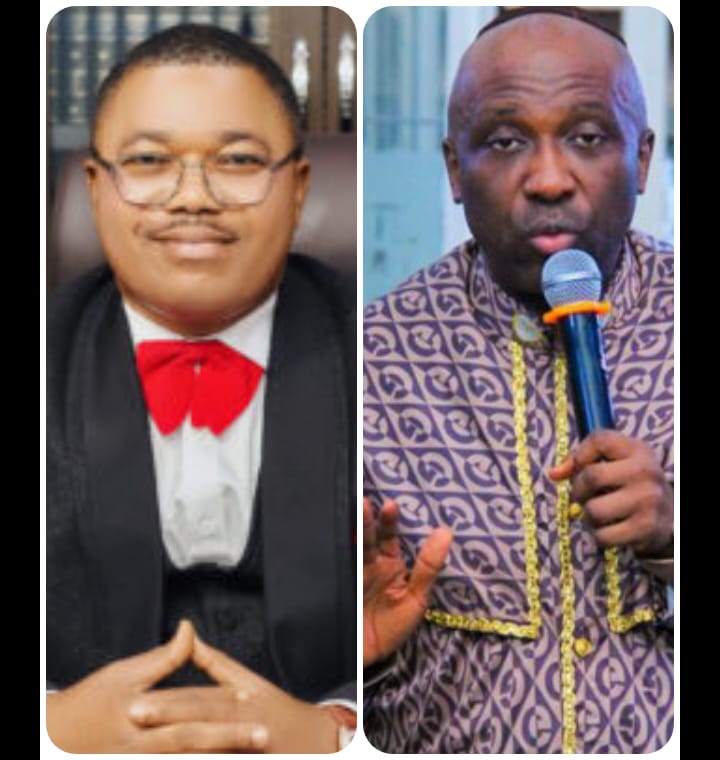
Human rights lawyer, Ifeanyi Ejiofor, has taken a swipe at popular cleric Primate Elijah Ayodele, accusing him of turning the pulpit into a platform for political forecasting and creating confusion through incessant prophecies on Nigeria’s political landscape.
Ejiofor made his position known in a statement titled, “Weekend Musings: When the Pulpit Becomes a Political Forecasting Centre: A Modest Appeal to Primate Ayodele to Choose Between the Cassock and the Campaign Field.”
In the statement, Ejiofor lamented what he described as the growing trend of some religious leaders abandoning their core spiritual mandate in favour of political predictions and partisan commentary.
According to him, one of the greatest challenges confronting contemporary Christianity is the gradual transformation of sacred altars into centres for political speculation.
“Prophecy, once reserved for the salvation of souls and spiritual guidance, now competes vigorously with election forecasts, power permutations and partisan calculations,” he stated.
Ejiofor argued that clergymen are primarily called to be custodians of faith, moral guides and ambassadors of God’s kingdom rather than constant commentators on political developments.
“Men clothed in cassocks are expected to be fishers of men, guardians of morality and ministers of reconciliation. Their divine mandate is neither ambiguous nor negotiable,” he said.
The legal practitioner noted that Ayodele has, in recent years, carved out a distinctive place in Nigeria’s public discourse through a relentless stream of prophecies, warnings and predictions, many of which centre on elections, political office holders and power struggles.
“Hardly a day passes without another prophecy, projection, forecast or political bulletin emerging from his altar,” Ejiofor remarked.
He added that the frequency of such pronouncements has become so overwhelming that many Nigerians now anticipate Ayodele’s forecasts like election results, opinion polls and intelligence briefings.
Clergyman or political analyst?
“At times, one struggles to determine whether one is listening to a clergyman delivering divine messages or a political analyst offering electoral projections under ecclesiastical cover,” he said.
Ejiofor acknowledged every citizen’s constitutional right to freedom of expression.
He however argued that persistent injection of prophetic declarations into partisan politics raises important questions about the role of the Church in a democratic society.
He warned that constant prophecies predicting electoral victories, impeachments, conspiracies, betrayals and political crises could heighten public anxiety and undermine confidence in democratic processes.
“One must ask: At what point does prophecy cease to be spiritual guidance and begin to resemble political fortune-telling?” he queried.
Ejiofor cited biblical passages, including Matthew 28:19-20 and 2 Timothy 4:2, to reinforce his argument that the central mission of Christian ministry is evangelism, repentance, righteousness and spiritual transformation.
He also referenced 2 Timothy 2:4, where Apostle Paul admonished believers against becoming entangled in worldly affairs capable of distracting them from their divine calling.
“The irony is impossible to ignore. While moral decay and social challenges persist, some ministers appear unusually preoccupied with who will win elections, who will lose office and who is plotting against whom,” he said.
Ejiofor maintained that the Church performs its highest duty when it serves as the conscience of society rather than an unofficial extension of political contestation.
He called on Ayodele to consider openly joining the political arena rather than operating through perpetual prophetic interventions.
“The time may have come for a clear choice,” Ejiofor declared.
“Either the cassock remains devoted to preaching Christ and advancing God’s kingdom, or its wearer embraces the political wrestling ring and contests openly with politicians.”
He stressed that Nigeria needs prophets who speak truth to power rather than those who appear fascinated by power itself.