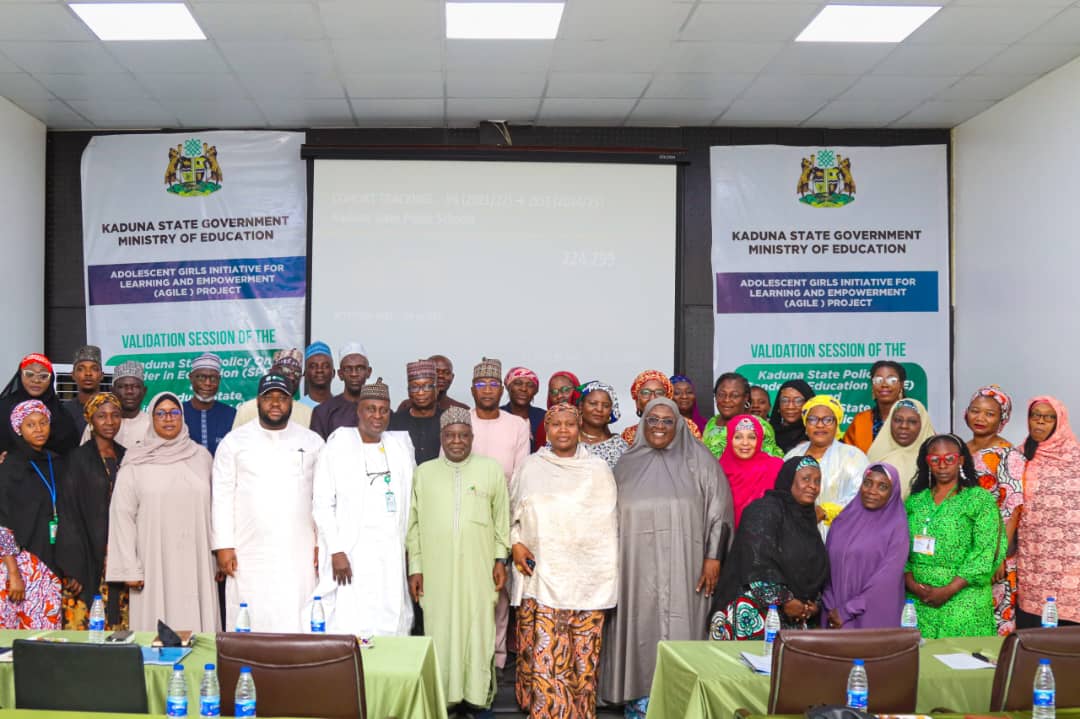
The Kaduna State Government has taken a major step toward addressing long-standing inequalities in its education sector with the validation of two strategic policy frameworks on Gender in Education and Life Skills.
The validation exercise, held in Kaduna, brought together policymakers, development partners, education experts, and civil society organisations to refine the documents ahead of their final adoption.
Speaking at the event, the Commissioner for Education, Abubakar Sani Sambo, said the policies are designed to close systemic gaps in access, participation, and learning outcomes—particularly for girls and other vulnerable groups.
He explained that the Gender in Education Policy provides a comprehensive roadmap for promoting safety, equity, and inclusiveness in schools, while addressing structural barriers that have historically limited opportunities for many children.
A key feature of the policy, according to Professor Sambo, is its reliance on detailed, localised data across Kaduna’s 23 local government areas—marking a shift from the traditional one-size-fits-all approach.
He noted that the state is setting a new benchmark by documenting the unique challenges and opportunities within each locality to guide targeted implementation.
On the Life Skills Policy, the commissioner said it aims to equip students with essential competencies beyond academics, including critical thinking, communication, resilience, and decision-making skills needed to succeed in a rapidly changing world.
He added that integrating these skills into the curriculum would also expand economic opportunities for young people, especially girls.
Panel session
During a panel session, Permanent Secretary in the Ministry of Internal Security and Home Affairs, Bashir Muhammad, highlighted that the framework embeds entrepreneurship as a core component of learning.
He noted that despite the involvement of multiple development partners, past efforts have often been fragmented, underscoring the need for a unified and coordinated policy direction.
Muhammad assured that the state government has taken full ownership of the reforms, with clear implementation strategies supported by budgetary allocations and sector plans to ensure long-term sustainability.
Also speaking, Director of Planning in the Ministry of Education, Salisu Baba Lawal, said systems have been established for continuous review of the policies to track progress and respond to emerging challenges.
Stakeholders at the workshop identified critical social issues—including early marriage, teenage pregnancy, and gender-based violence—as key factors contributing to low school enrolment and retention, particularly among girls.
In her remarks, Executive Director of the Centre for Girls’ Education, Habiba Mohammed, emphasised that empowering girls through education and life skills would enable them to make informed choices and resist harmful practices.
Similarly, Kaduna State AGILE Project Coordinator, Maryam Dangaji, said effective implementation of the policies would significantly reduce dropout rates and improve transition and completion levels for girls.
She stressed that the initiative is focused on ensuring every girl is enrolled, retained, and successfully completes her secondary education.
Participants highlighted the importance of the policies in promoting equal access to education for all children and adolescents.
They also called for sustained political will, adequate funding, teacher capacity development, and strong monitoring systems to ensure successful implementation.