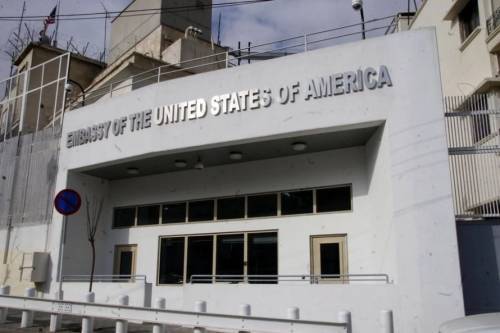
Human rights lawyer, Ifeanyi Ejiofor, says the decision by the United States Government to authorize the departure of non-emergency staff and their families from its embassy in Nigeria is a serious indication of worsening insecurity in the country.
In a strongly worded statement on Thursday, Ejiofor said the move goes beyond routine administrative action and should be interpreted as a clear warning signal to Nigerian authorities.
According to him, the decision to allow non-essential personnel to leave the United States Embassy Abuja reflects deepening concerns about the country’s security environment.
“It sends an unmistakable signal that all is far from well within our security architecture,” he stated.
Ejiofor argued that in a system driven by foresight and responsiveness, such a development would ordinarily trigger urgent and coordinated action to address the underlying threats.
Instead, he lamented what he described as a growing disconnect between the scale of insecurity and the urgency of government response.
Referencing recent developments, the lawyer noted that insecurity across several regions including the North-West, North-Central, North-East, and parts of the Middle Belt has continued to escalate with frequent reports of attacks on communities and rising casualties.
He expressed concern that despite intelligence warnings in some instances, preventive measures are often inadequate or delayed, leaving vulnerable populations exposed to violence.
Ejiofor criticized what he described as a recurring pattern of delayed reactions, followed by official statements that do little to address the human cost of such incidents.
“The victims are not abstractions; they are ordinary citizens left unprotected,” he said, stressing that security challenges should not be reduced to mere statistics or routine briefings.
Prioritizing politics
The lawyer also took a swipe at what he termed the government’s focus on political strategizing ahead of the 2027 general elections.
He warned that governance must prioritize the protection of lives over political calculations.
In a pointed remark, he questioned whether electoral preparations were being made for citizens whose safety remains uncertain amid rising insecurity.
Ejiofor maintained that the United States’ decision should not be dismissed or downplayed.
He emphasized that actions taken by foreign missions often reflect careful assessments of on-ground realities.
“The decision is not merely administrative—it is emblematic.
“It should prompt serious reflection and decisive measures, not be met with bureaucratic inertia.”
He warned against what he described as a culture of “perception management” in place of effective governance.
The human rights lawyer argued that public relations responses cannot substitute for concrete action in addressing security threats.
The development, he noted, underscores the need for a more proactive and intelligence-driven security framework capable of preventing attacks rather than responding after the fact.
Ejiofor ultimately called on authorities to treat the situation with the urgency it deserves, stressing that the protection of lives and restoration of public confidence must take precedence in national priorities.