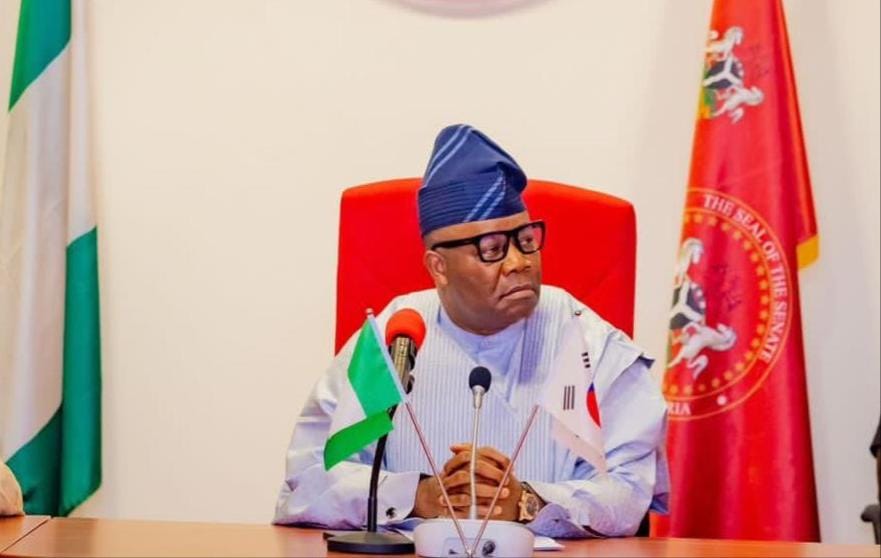
Nigeria’s Senate President, Godswill Akpabio, has called on legislatures worldwide to step into a more decisive global role, declaring that parliaments—not just presidents or prime ministers—must now serve as the moral anchors of society.
Speaking at the 152nd Assembly of the Inter-Parliamentary Union (IPU), Akpabio urged lawmakers across continents to rethink their responsibilities at a time marked by conflict, inequality and declining trust in leadership.
He stressed that parliaments must move beyond routine lawmaking to actively defend peace, justice and human dignity, positioning them as guardians of global stability rather than passive institutions.
At a time when traditional centres of power are facing increasing pressure, Akpabio argued that legislatures must evolve to fill the leadership gap.
Describing parliaments as “the conscience of the people” and “the first hope of the masses,” he warned that silence in moments of crisis is no longer an option.
Drawing from Nigeria’s own journey through conflict and nation-building, Akpabio reminded delegates that peace is neither automatic nor enduring, but must be continuously built, protected and sustained.
He cautioned against a global drift toward dominance by force, warning that the world risks normalising power over justice.
“This is not merely a crisis of security; it is a crisis of leadership. Might must not be mistaken for right,” he said.
Unequal power dynamics
Framing his remarks as both a call to action and a critique of the current global order, Akpabio highlighted how unequal power dynamics often leave weaker nations and vulnerable populations exposed.
He urged countries to rethink priorities, advocating a shift from conflict-driven spending to investments in development and human progress.
“It is time to turn from destruction to construction,” he said.
Akpabio also pointed to the IPU’s potential as a balancing force in global governance, calling for stronger collaboration with the United Nations and a renewed commitment to multilateralism rooted in fairness rather than influence.
In closing, his message took on a broader, forward-looking tone—emphasising not just immediate political challenges, but the enduring responsibility of leaders to shape a more just and peaceful world for future generations.