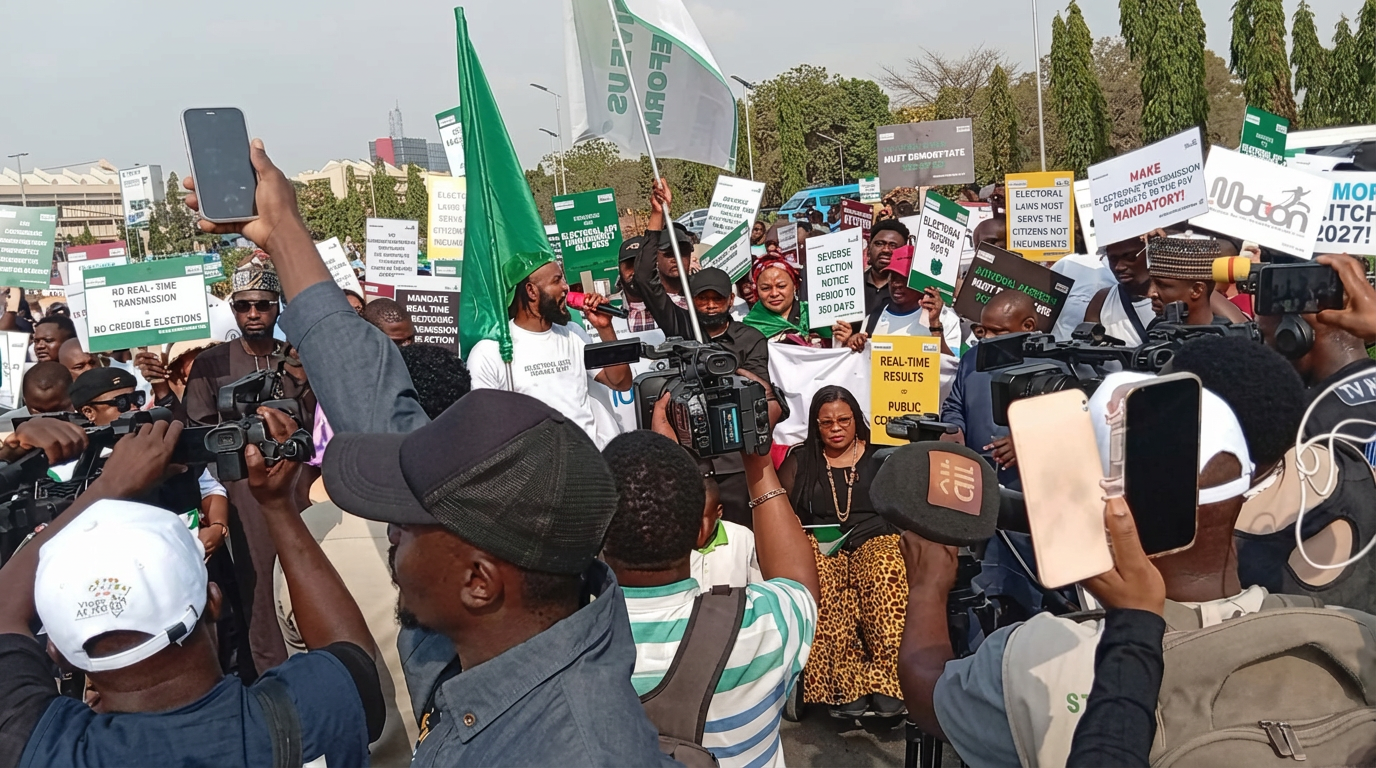
A broad coalition of Nigeria’s young activists and veteran democrats on Tuesday stormed the National Assembly Complex with a clear and uncompromising message: reform the electoral system now or risk plunging the country into deeper political instability ahead of the 2027 general elections.
Addressing journalists at a strategic world press conference in Abuja, the Movement for Credible Elections (MCE) declared that the credibility of Nigeria’s democracy hangs in the balance.
The coalition, inaugurated at a National Summit on Electoral Reforms in November 2025, accused the National Assembly of stalling and weakening critical amendments required to restore public trust in elections.
Flanked by labour leaders, civil society actors, youth mobilisers, lawyers, academics and elder statesmen, the conveners reflected a deliberate blend of generational voices.
From seasoned reform advocates to youth coordinators and grassroots mobilisers, the message was unanimous: Nigeria cannot afford another disputed election cycle.
A System in Decline
The coalition warned that citizens’ confidence in elections has steadily eroded due to recurring patterns of electoral violence, voter suppression, vote buying, poor logistics, and what it described as manipulation during collation and transmission of results.
“These problems are no longer isolated incidents. They have become systemic,” the group declared.
Without decisive constitutional and electoral reforms, MCE warned, the 2027 elections face a serious credibility crisis that could fuel public resentment and weaken democratic legitimacy.
Mandatory Electronic Transmission
At the heart of the coalition’s demands is a firm insistence that electronic transmission of results be made mandatory and immediate through the INEC Result Viewing Portal (IREV).
MCE argued that ambiguities in the Electoral Act 2022 have enabled manual interference after polling unit results are known.
The refusal to enshrine mandatory electronic transmission in law, the group said, leaves open opportunities for manipulation between polling units and final collation centres.
The coalition further called for the introduction of a Voters Verifiable Paper Audit Trail, similar to the model practised in India, to complement electronic transmission and allow cross-checking of results.
Strengthening INEC and Electoral Offences
Beyond technology, the group demanded stronger sanctions for electoral offences, including vote buying, intimidation, assault on election officials and falsification of results.
It insisted that enforcement mechanisms must be practical and coordinated with security agencies and the judiciary.
MCE also pressed for constitutional amendments to guarantee the operational independence of the Independent National Electoral Commission (INEC), including transparent and merit-based appointments of its leadership as recommended in the Justice Uwais Report.
Among those lending advisory weight to the campaign are senior advocates and reform advocates such as Femi Falana, Oby Ezekwesili, and Shehu Sanni, reflecting the movement’s cross-sector legitimacy.
Youth, Women and Diaspora Inclusion
Significantly, younger voices within the coalition emphasized inclusive participation.
The group called for reforms to expand opportunities for youth, women and persons with disabilities, alongside provisions for diaspora voting and early voting for essential workers.
The coalition also targeted political defections, aligning with popular demands to amend Sections 68 and 109 of the Constitution to ensure that elected officials who defect automatically lose their seats.
It further called for limits on pre-election judicial orders that disrupt electoral timetables and insisted that election petitions be resolved before winners are sworn into office.
“Allowing disputed mandates to be exercised while cases drag on undermines justice and rewards malpractice,” the coalition stated.
Occupy NASS
In a bold conclusion, MCE announced that it would sustain nationwide civic mass actions under the banner “Occupy NASS” until lawmakers accede to what it described as non-negotiable reforms.
“The ongoing mobilization is a peaceful defence of the popular will and a clear rejection of any attempt to return Nigeria to manual manipulation and backroom result fabrication,” the group declared.
“Democracy dies when votes are stolen. It is time to end electoral rigging in Nigeria.”
With labour leaders, policy experts, grassroots activists and elder statesmen standing shoulder to shoulder, the press conference signaled not merely another advocacy statement but the emergence of a coordinated civic front determined to shape the rules of the 2027 contest before campaigns even begin.