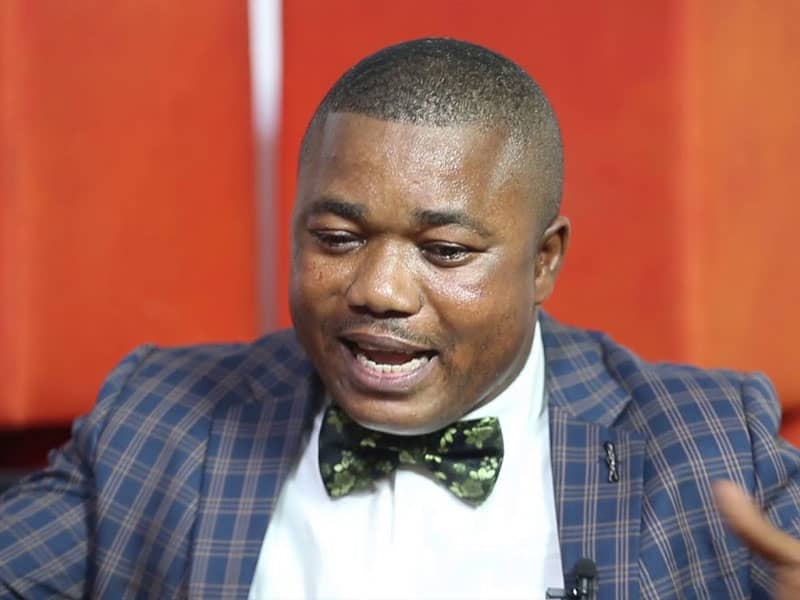
Nigerian human rights lawyer, Ifeanyi Ejiofor, has condemned what he described as a coordinated media attack on Mr. Emeka Umeagbalasi, Chairman of the International Society for Civil Liberties and Rule of Law (Intersociety), over his documentation of persecution and terrorism in Northern Nigeria.
Ejiofor said the attacks, which accuse Umeagbalasi of exaggerating evidence of Christian persecution, amounted to a dangerous distortion of facts and a deliberate assault on journalistic and civil society independence.
The lead counsel to the Indigenous People of Biafra (IPOB) described the campaign as “a further descent into what he termed ‘the theatre of the absurd.’”
In a statement titled “Monday Musing: When Power Confuses Noise for Truth — Paid Lobbyists, Media Charlatans, and the Futile Hunt for Journalistic Sources in a World at War with Terror,” issued on Monday, Ejiofor faulted claims that Umeagbalasi’s work allegedly influenced recent policy actions attributed to United States President, Donald Trump.
According to Ejiofor, “there is a peculiar arrogance that often accompanies paid advocacy when it strays beyond its lawful and ethical brief.”
He said such arrogance assumes “repetition can transmute falsehood into fact” and that “intimidation may substitute for reason.”
Ejiofor contended that Umeagbalasi had become the target of “a carefully choreographed media lynching,” noting that critics alleged without evidence that his documentary work constituted the exclusive basis for recent policy actions attributed to the President of the United States, Donald Trump.
Logic of claims queried
He challenged the logic behind the claims – “when did advocacy degenerate into farce, and when did journalism become answerable to lobbyists?”
“Are we seriously being invited to believe that the President of the United States, presiding over the most sophisticated intelligence architecture in human history, encompassing the CIA, FBI, NSA, DIA, satellite surveillance systems, human intelligence networks, and allied security apparatus across continents, would predicate consequential military or diplomatic decisions on a single documentary or civil society report originating from Nigeria?”
Describing the allegation as an insult to common sense, Ejiofor said the idea trivialised global intelligence operations.
He remarked sarcastically that if such logic held, “one might reasonably wonder why trillions of dollars are expended annually on intelligence gathering, when apparently a Google search and a Nigerian documentary would suffice.”
He urged critics to return to verifiable facts insisting that persecution and mass killing of Christians persist in Northern Nigeria.
“This reality has been independently reported by Amnesty International, Human Rights Watch, the United States Commission on International Religious Freedom (USCIRF), and multiple United Nations agencies.”
He also affirmed that Boko Haram, ISWAP, jihadist bandits and insurgent networks continue to operate across the North-East, North-Central and North-West.
Established state policy
Ejiofor stated that Nigeria’s cooperation with the United States and other partners on counter-terrorism was established state policy and not a clandestine arrangement.
He added that Nigeria required foreign intelligence, logistics and military assistance to combat terrorism effectively.
“These are not opinions but empirical realities. Those who profit from insecurity inevitably resent transparency.
“Those whose relevance depends on controlled narratives will instinctively recoil when external scrutiny threatens to expose domestic complicity, incompetence, or collusion.”
He warned that opposing international collaboration without credible alternatives amounted to enabling terrorism by omission.
Ejiofor stressed that “international collaboration in intelligence sharing, counter-terrorism training, surveillance, and targeted operations is not a surrender of sovereignty; it is an assertion of survival.”
He maintained that “journalists are not court clerks for lobbyists,” and that the attempt to trivialize Umeagbalasi’s work represented “an assault not merely on one advocate/activist, but on the very oxygen of democracy.”
The human rights lawyer cautioned that history would not be kind to those who chose silence in the face of terror.
He urged: “Let journalism breathe. Let the law speak. And let those who profit from chaos tremble at the prospect of light.”