
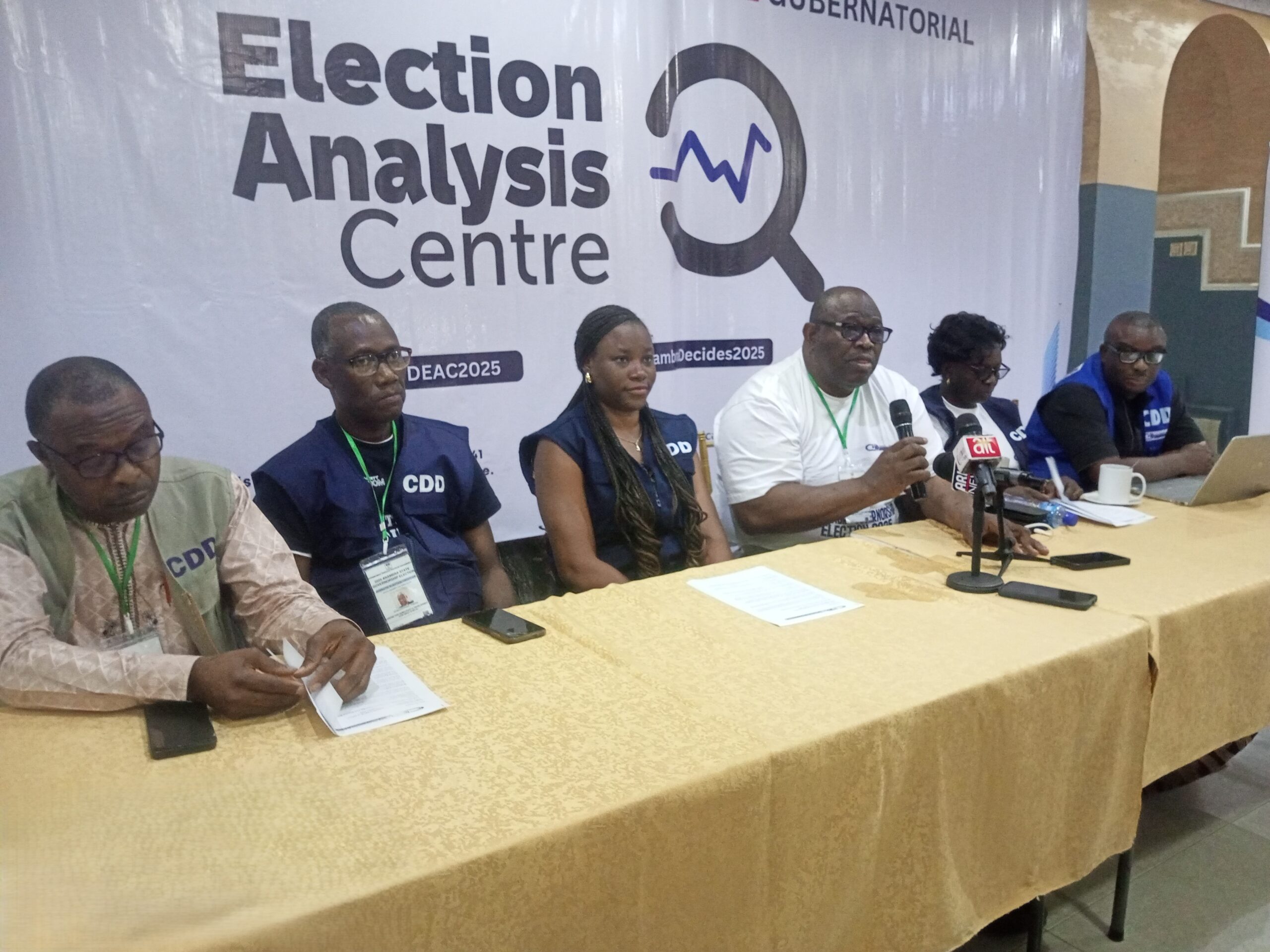
The Centre for Democracy and Development (CDD Africa) says the just-concluded Anambra State governorship election provided both evidence of progress and stark reminders of persistent challenges facing Nigeria’s democracy and electoral process.
In its final assessment released through the Election Analysis Centre (CDD-EAC), the organisation noted that while the election reflected improved performance by electoral institutions and a largely peaceful atmosphere, it also exposed recurring issues such as low voter turnout, vote trading, weak political mobilisation, and widespread disinformation.
According to the statement jointly signed by CDD Director, Dr. Dauda Garuba, and Chair of the Election Analysis Centre, Prof. Victor Adetula, the Independent National Electoral Commission (INEC) achieved commendable progress with a 98.8% Permanent Voter Card (PVC) collection rate, 99.62% result upload on IReV, and generally peaceful conduct.
However, about 5.4% of polling units experienced late arrival of INEC officials, while political parties were faulted for their failure to mobilise voters effectively or conduct issue-based campaigns. “The campaign period was marked by low visibility and an absence of issue-based campaigns, which contributed significantly to the lack of competitiveness observed during the election,” the report stated.
Security and Vote Trading
The CDD commended the deployment of over 45,000 security personnel, which ensured a peaceful atmosphere in most polling units. Security agents were present in 87.3% of the areas observed, while 12.7% recorded no presence. It, however, questioned the sustainability of such massive security operations after elections, warning that many flashpoint communities could relapse into insecurity once troops withdraw.
The report decried widespread vote buying across several local government areas, where voters were offered between ₦2,000 and ₦10,000 through cash or digital transfers in full view of security operatives and party agents. CDD described this as “a persistent feature of Nigeria’s elections,” fuelled by the absence of issue-based campaigning and poor governance.
Despite high voter registration figures, turnout stood at 21.4%, a slight improvement from 10.2% in 2021, but still a troubling sign of voter apathy. The report also highlighted barriers faced by women and persons with disabilities (PWDs), including poor accessibility to polling booths and lack of assistive materials.
Information Disorder and Disinformation
CDD tracked over 200 online claims related to the election, with 45 identified as fact-checkable. Analysis revealed that 54% were false, 27% true, and 10% misleading. Disinformation, the group said, targeted candidates, INEC, and security agencies—often exploiting insecurity narratives, hate speech, and even artificial intelligence-generated content to distort public perception.
The organisation concluded that the Anambra election exposed how Nigeria’s electoral challenges are rooted in broader governance failures—weak institutions, elite dominance, economic hardship, insecurity, and lack of accountability.
It urged government and stakeholders to strengthen INEC’s operational capacity through timely funding, decentralised logistics, real-time result publication, early voting for essential workers, and improved staff training. Political parties, it said, must focus on voter education, internal democracy, and transparent campaign financing.
CDD cautioned against viewing elections merely as temporary security events, calling for a sustainable year-round security framework that addresses root causes of violence rather than relying on costly one-off deployments.
To combat vote trading and disinformation, it called on the National Orientation Agency (NOA) to intensify civic education efforts and on the media, security agencies, and civil society to collaborate in countering fake news. INEC, it added, should improve inclusivity through partnerships with disability organisations and ensure availability of voting aid materials.
“As the nation prepares for the 2026 off-cycle and 2027 general elections, these reforms must be prioritised,” CDD said, stressing that Nigeria’s democratic survival depends not only on voting but on “the strength of institutions and governance practices that sustain it.”