Alfred Ajayi
Incumbent Governor and candidate of the All Progressives Grand Alliance, (APGA), Professor Charles Chukwuma Soludo was declared winner after INEC collated results from all 21 local government areas, polling 422,664 votes against his closest rival’s 99,445.
INEC reported about 2.79–2.80 million registered voters for the election; roughly 598,000 were accredited and about 595,298 votes were cast, with 584,054 valid votes. Observers broadly described the exercise as decisive and, in many places, orderly — but they also flagged a set of recurring and systemic problems that need urgent attention.
Pre-election concerns: security hotspots and information risks
In the run-up to polling, multiple organisations issued warnings about security risks concentrated in specific LGAs. CLEEN Foundation’s security and threat assessment identified a number of “high-risk” LGAs (citing prior killings, attacks on INEC installations, abductions and persistent violations of sit-at-home directives) and urged stepped-up, intelligence-led security planning. Observers argued that these risks — including armed non-state actors and politically-sponsored violence — could undermine voter confidence if not mitigated.
Alongside physical security threats, analysts also warned that the information environment had become an independent risk vector. Briefings from CDD-West Africa and civil-society monitoring noted a sophisticated disinformation ecosystem — coordinated narratives, deepfakes and targeted social media campaigns — intended to confuse voters and seed doubt about results. Observers recommended proactive digital literacy campaigns and rapid-response fact-checking ahead of election day.
Election day administration, turnout and logistics
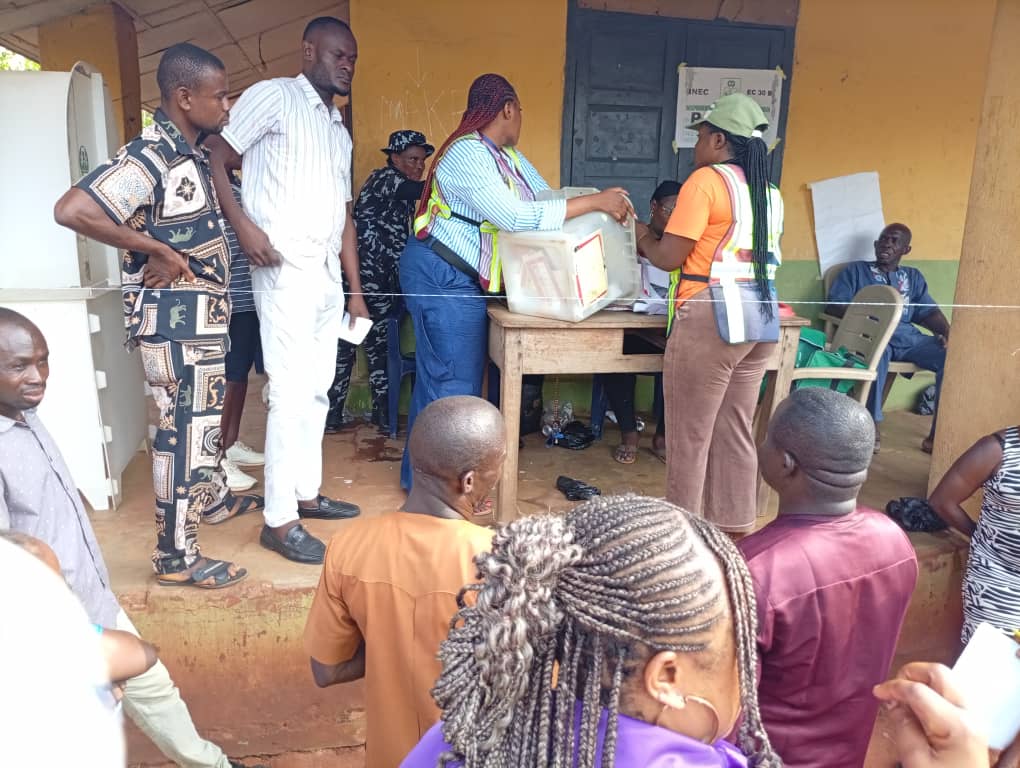
On election day many polling units opened and voting proceeded without major disruption, with widespread use of INEC’s card reader and established collation processes. Large margins in favour of Soludo across LGAs and the rapid flow of LGA collation results helped INEC finish state collation in good time.
However, problems persisted in pockets: observer missions reported isolated incidents of late opening of polling units, logistics hiccups (materials arriving late), and episodes of low-level intimidation or vote inducement in some areas — classic friction points that cumulatively affect perceptions of fairness.
A notable administrative issue emerged immediately after polling: INEC acknowledged unrecorded results in six local government areas during the collation process, then worked to reconcile and confirm outcomes — and said the overall outcome was unaffected. Such occurrences, while managed in this instance, fuel post-count disputes unless collation transparency is tightened.
What observer missions found
Two strands in Civil Society observations merit emphasis. First, process-level monitoring: organisations like Yiaga Africa, the European-supported Watching the Vote hub and other domestic coalitions deployed statistically-based verification methods (PRVT and processes tracking) and large observer contingents.
Yiaga Africa reported that its independent PRVT estimates matched INEC’s official results closely, a strong signal that the collation reflected polling-unit returns rather than wholesale fabrication at collation centres. This independent alignment was the most important reassurance that the announced outcome mirrored votes on the ground.
Second, security and procedural observations: CLEEN and other security-focused groups noted improvements in the visible deployment of security personnel, but insisted on careful after-action reviews, especially in the “high-risk” LGAs identified pre-election.
Observers emphasised the importance of proportional, rights-respecting security responses rather than heavy-handed tactics that can intimidate voters.
Allegations, contested narratives
Despite observers’ overall validation, some opposition parties and commentators alleged irregularities, particularly vote-buying and localized manipulation. Media reports captured immediate contestation and legal posturing — a typical feature of competitive elections, and one that will likely produce court filings and further scrutiny.
The public debate has therefore bifurcated: observer data signaling consistency with official returns versus contested claims by some political actors about malpractice. This divergence underlines why both robust independent monitoring and transparent redress mechanisms are indispensable.
Attention was also drawn to information integrity: disinformation and trust. Observers’ attention to the information ecosystem is salient. CDD-West Africa’s briefing and media fact-checking groups documented active misinformation campaigns in the lead-up to the vote and on election night — some aimed at delegitimising INEC and others designed to stoke post-result unrest.
The capacity to produce rapid, credible counter-narratives and the presence of trusted civic fact-checkers was decisive in preventing misinformation from metastasizing into violence; still, the scale of organised manipulation reveals a deep institutional vulnerability.
Policy implications and recommended reforms
Tighter logistics and contingency planning: INEC should publish a post-election logistics audit addressing late openings and the “unrecorded results” episodes, and commit to real-time public dashboards during collation in future polls.
Targeted security strategy for high-risk LGAs: Move from bulk deployments to intelligence-led, community-anchored security that protects election officials and voters without intimidating turnout; incorporate CLEEN’s risk mapping into permanent INEC-security planning.
Strengthen anti-vote-buying enforcement: Observers repeatedly flagged inducement. A legal and operational clampdown—faster investigations, visible prosecutions where evidence exists, and civic campaigns about the illegality and long-term harms of vote-buying—will be essential.
Invest in the information environment: Fund rapid fact-checking hubs, bolster media literacy at community level, and require social platforms to fast-track takedowns of election-related disinformation in partnership with civil society.
Sustain independent verification practices: The PRVT and similar statistically rigorous observer methodologies proved their worth; institutionalising access for accredited observer sampling will keep collation transparent and credible.
Conclusion
The 8 November Anambra governorship election combined clear strengths — a decisive outcome, large-scale citizen participation in many areas, and independent verification that largely matched official returns — with structural weaknesses (localized insecurity, logistics shortfalls, vote-buying and an aggressive disinformation ecosystem).
Observers’ work did more than certify results: it mapped problem areas that, if addressed, could make Anambra a model for better-run off-cycle elections in Nigeria. The challenge now is less about a single result than about converting the lessons of this contest into durable institutional fixes: better logistics, smarter security, stronger anti-corruption enforcement, and a resilient information ecosystem.
Those reforms will determine whether the next election in Anambra is not only peaceful and decisive, but also incontrovertibly fair.