
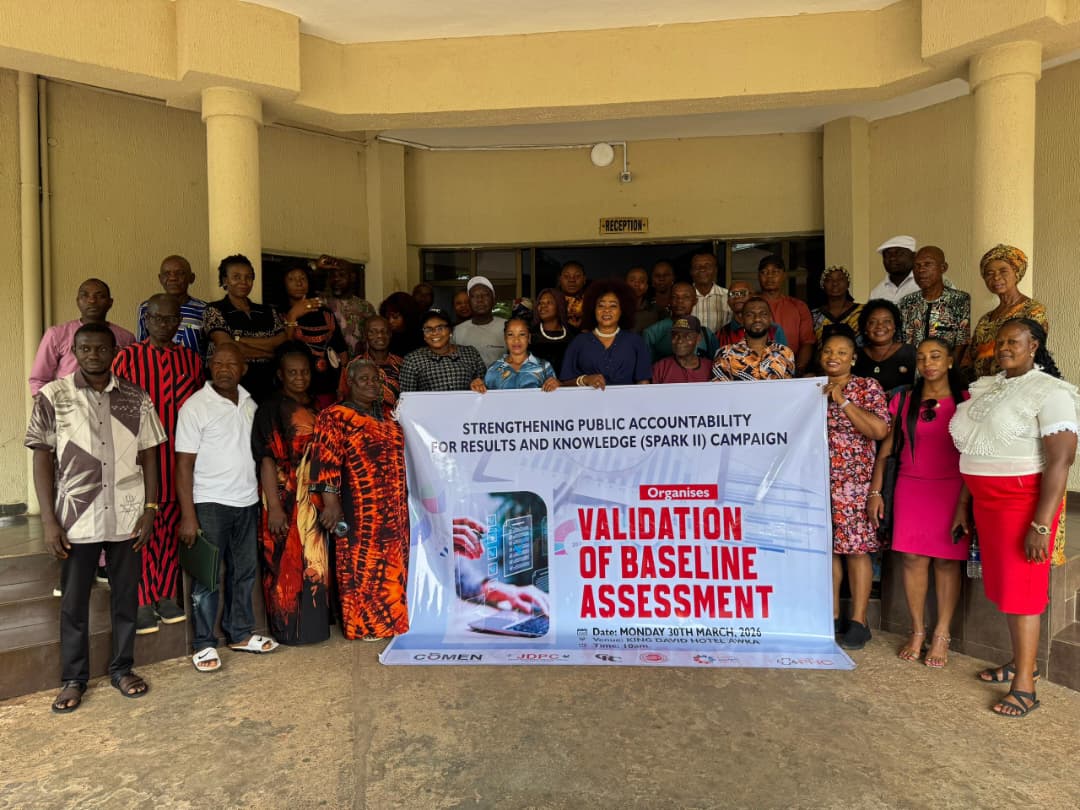
Stakeholders in Anambra State’s health sector have reaffirmed their commitment to improving primary healthcare delivery following a baseline validation meeting held under the Strengthening Public Accountability for Results and Knowledge (SPARK 2) Project.
The session brought together government officials, development partners, members of Ward Development Committees (WDCs) Community Empowerment Network, (COMEN) and civil society representatives.
It was organized by Justice Development and Peace Caritas (JDPC Nnewi) in collaboration with the Social and Integral Development Centre (SIDEC).
The meeting reviewed and validated key findings from a comprehensive assessment of the Basic Health Care Provision Fund (BHCPF) and related interventions across selected local government areas and health facilities in the state.
The Executive Director of Social and Integral Development Centre (SIDEC), Ugochi Ehiahuruike, explained that the findings will guide policy and programmatic decisions for the Anambra State Primary Health Care Development Agency and the Ministry of Health.
“These findings are not limited to Anambra alone; they form part of broader interventions by the International Budget Partnership across multiple sectors, including health and agriculture in Nigeria.”
Ehiahuruike explained that the health component uses the Basic Health Care Provision Fund as an entry point, and detailed assessments were conducted on transparency, implementation processes, and inclusivity.
“The study paid particular attention to vulnerable groups such as women with disabilities, children under five, widows, single mothers, and other underserved populations.
“With a focus on maternal and child healthcare delivery, the data revealed that Anambra State is performing strongly compared to other participating states.
“The government representatives were fully involved from the beginning, collaborating from planning through implementation.
The findings are co-created, making it easier for stakeholders to accept and adopt the results,” Ehiahuruike noted.
Opportunity to review
Onyekachi Ololo, SPARK Programme Manager for Justice Development and Peace Caritas, highlighted that the baseline validation involved a mixed-method approach, combining surveys, key informant interviews, and group discussions.
“This validation allows stakeholders to review, contribute to, and align with the findings.
“Many of the concerns raised by both community members and government actors were already captured in our baseline data, reinforcing its credibility,” Ololo said.
He further noted that the baseline serves as a foundation for advocacy, policy engagement, and evidence-based programme design.
“During the meeting, key issues identified included staffing gaps, particularly in rural health facilities, high out-of-pocket healthcare expenditure, limited women’s participation in Ward Development Committees (WDCs), and the need for inclusive facilities for persons with disabilities.
“Other recommendations included improving transparency in the management of the BHCPF, deploying sign language interpreters where necessary, strengthening telecommunications in rural communities, and introducing community scorecards to track local accountability.
“Looking ahead, the SPARK 2 Project aims to significantly increase women and girls’ access to primary healthcare services, particularly maternal health, by 2030.
“By 2028, women’s participation and leadership in WDCs is targeted to rise from the current 13 percent to at least 30 percent.
“The project also seeks to enhance transparency, accountability, and community-driven planning in the management of the BHCPF, while continuing to track recruitment and service delivery improvements in line with state and national health objectives,” he said.
Government officials present, including the Permanent Secretary of the Ministry of Health, Dr. Obiageli Uchebo (represented by the Director of Planning, Research, and Statistics, John Paul), and the Director of Planning, Research, and Statistics in the Ministry of Economic Planning and Budget, Mrs. Edith Nwachukwu, expressed readiness to continue partnering with the SPARK team to implement the recommendations.
Task for WDCs, COMEN
They tasked WDC and COMEN members to actively monitor and participate in the management of local primary healthcare facilities.
Mrs. Nwachukwu further stressed the need to integrate the health needs of communities into formal advocacy and government engagement channels, and to make facilities disability-friendly through ramps, sign language interpreters, and other accommodations.
Christabel Chiamaka, BHCPF Focal Person at the State Primary Healthcare Development Agency, also acknowledged staffing gaps and reassured stakeholders that the government would recruit more health workers to strengthen service delivery.
“Addressing these gaps, along with improving welfare packages and infrastructure in rural areas, was highlighted as critical to sustaining progress and improving health indices across the state.
At the close of the meeting, all stakeholders expressed strong commitment to maintaining a collaborative partnership with the SPARK team to strengthen primary healthcare in Anambra State.
The session underscored the shared responsibility of government, communities, and development partners in achieving sustainable, inclusive, and accountable healthcare service delivery across the state.