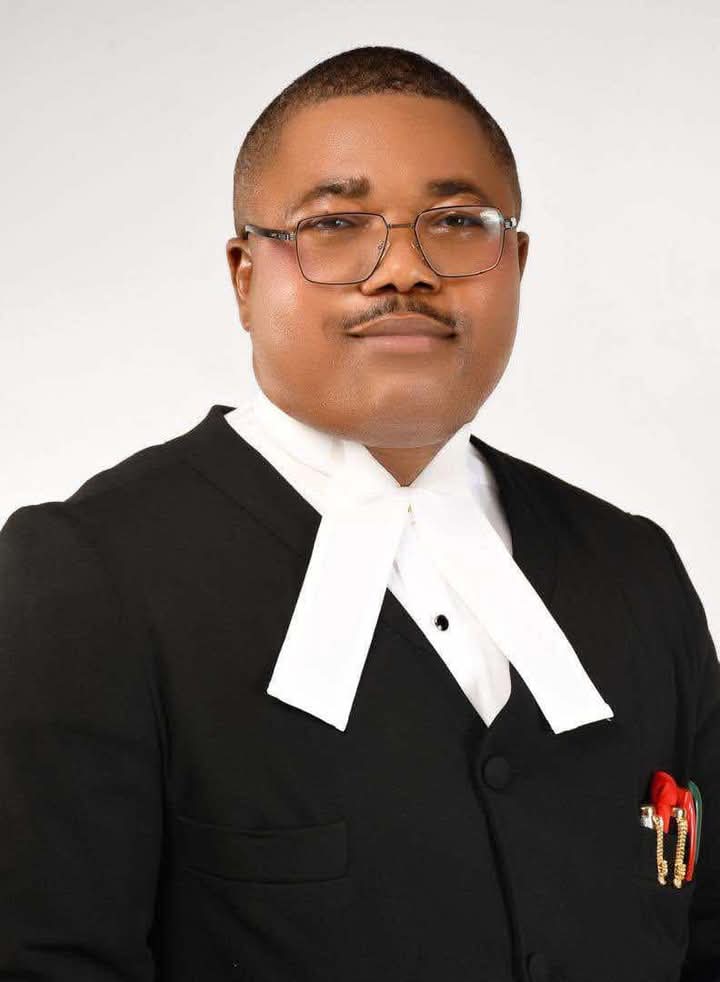
Human rights lawyer Ifeanyi Ejiofor, has raised serious concerns over what he described as a disturbing escalation of terror in Nigeria’s North-East region.
This followed reports that suspected jihadist militants killed at least 27 Christians in Adamawa State.
Ejiofor in a statement said the development paints a troubling picture of insurgent groups assuming the role of authorities in vulnerable communities.
The attack occurred in Kirchinga and Garaha communities in Madagali Local Government Area of Adamawa State, where armed militants reportedly launched a brutal night-time assault on Christian residents.
Ejiofor said the attackers had earlier issued a chilling ultimatum to the communities, demanding that residents either convert to Islam, pay a levy imposed by the militants, or abandon lands their ancestors had inhabited for generations.
“It would appear that, in certain parts of our republic, terrorism has now acquired the bureaucratic elegance of a tax authority.
“One merely receives a notice: convert, pay, or vacate. Compliance is optional; survival, unfortunately, is not.”
He lamented that the militants allegedly carried out their threats barely two nights after issuing the warning, leaving dozens dead and forcing many residents to flee their homes in fear.
The human rights lawyer described the incident as another grim chapter in the security crisis ravaging Nigeria’s North-East.
Ejiofor noted that insurgent groups such as Boko Haram, the Islamic State West Africa Province (ISWAP), jihadist bandits and other militant factions continue to expand their operations with increasing boldness.
Survivors counting losses
As traumatized survivors in Madagali counted their losses, he said another disturbing attack was reported almost simultaneously in Ngoshe community in Gwoza Local Government Area of neighbouring Borno State.
Ejiofor regretted that armed fighters linked to Boko Haram and ISWAP reportedly stormed the settlement in large numbers, overwhelmed a military position and launched a devastating assault.
“Residents and soldiers were killed. Homes were set ablaze. More than one hundred civilians, mostly women and children, were abducted,” he said.
The attack triggered mass displacement, with thousands of residents reportedly fleeing to nearby communities such as Pulka in search of safety.
“How does such a large force of insurgents mobilise, travel across territories, overwhelm a military position, abduct over one hundred civilians, and disappear into the night, apparently without prior detection?” he asked.
He said the recurring pattern of large-scale attacks raises fundamental questions about Nigeria’s security architecture and the state’s ability to protect vulnerable communities.
“What makes these attacks particularly disturbing is not only their brutality but their scale, coordination, and confidence.
“Large columns of armed fighters move across vast terrains. Entire communities are invaded. Civilians are abducted in their hundreds.”
He noted that while insurgents appear to move with alarming mobility, government responses often come only after the attacks have occurred, usually in the form of official condemnations.
International dimension
The human rights lawyer also drew attention to an international dimension of the security crisis.
He referenced recent remarks by the Israeli Ambassador to Nigeria who alleged that Iran plays a significant role in the proliferation of arms and sponsorship of jihadist activities across parts of Africa.
According to Ejiofor, if the claim holds any truth, Nigeria’s security agencies must investigate it with urgency.
“If external actors are indeed fueling insurgent violence within our borders, then the challenge confronting Nigeria is not merely insurgency; it is proxy warfare by other means,” he said.
He stressed that for communities in the North-East, the crisis has gone beyond a security concern and has become a daily struggle for survival.
“Until the state discharges its duty with clarity, competence and resolve, Nigerians will continue to ask a troubling question: who truly controls the night in these territories — the state, or the insurgents?” he added.