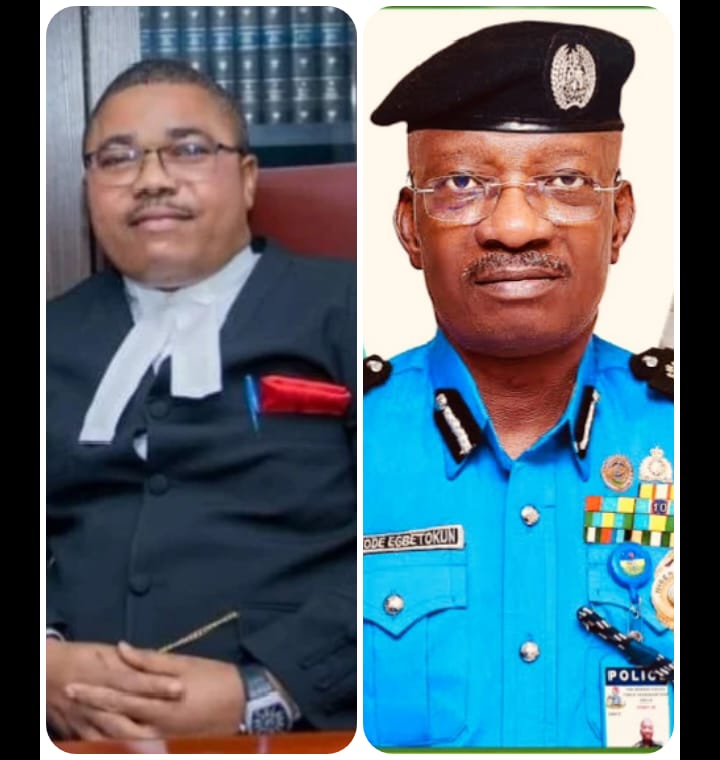
Nigerian human rights lawyer Ifeanyi Ejiofor, has described the exit of former Inspector-General of Police, Kayode Egbetokun, as the end of “a chapter many would rather forget than footnote.”
He gave the indication in a statement issued Wednesday titled “Midweek Musing: When Tenure Outlives Trust — Egbetokun Years and the Crisis of Command,”.
Ejiofor, the lead counsel to the Indigenous People of Biafra (IPOB), argued that his extended tenure deepened public distrust and failed to confront longstanding structural weaknesses within the Nigeria Police Force.
According to him, although the Force’s institutional challenges predated Egbetokun, leadership is ultimately measured by its ability to reverse decline, not merely manage it.
What was inherited as a fragile institution, he said, was “not so much repaired as revarnished,” warning that cosmetic adjustments cannot conceal deep structural deficiencies indefinitely.
Ejiofor alleged that under Egbetokun’s watch, the Police grappled with persistent accusations of entrenched petty corruption, frequently rationalised as “field exigencies.”
He pointed to patterns of operational recklessness in crowd control and civil engagement, as well as what he described as a disciplinary framework that appeared ornamental rather than effective.
The human rights lawyer further criticised what he called opaque promotion and posting systems that fueled perceptions of patronage over merit.
In his view, such practices eroded morale within the ranks and weakened institutional credibility in the eyes of the public.
Prolonged tenure
He also described Egbetokun’s prolonged tenure as controversial in both optics and internal morale.
In a structured hierarchy where progression is traditionally sacrosanct, Ejiofor noted that the extension created what he termed a “peculiar paradox.”
“Senior officers retired in sequence; contemporaries stepped aside; yet the apex remained immovable,” he stated.
The human rights lawyer argued that such asymmetry inevitably breeds quiet resentment and suppressed morale among officers.
Ejiofor acknowledged that the Nigeria Police Force has long struggled with inadequate funding, welfare deficits, political interference and inconsistent training standards.
He maintained that leadership must be judged by its willingness to confront inherited problems with clarity and courage.
He also warned that corruption within policing structures is not merely an administrative flaw but a constitutional contradiction.
“A law enforcement body cannot command respect if it is perceived as commodifying justice.
Throughout Egbetokun’s tenure, Ejiofor said, public commentary frequently lamented the persistence of “roadside taxation” under official uniforms, investigations allegedly susceptible to inducement, and selective enforcement in politically sensitive matters.
He also criticised what he described as the inadequacy of transparent, independently verifiable accountability mechanisms.
“Such perceptions, whether universally fair or not, shape public trust. And in policing, perception is as consequential as performance,” he stated.
Disu inheriting reputationally bruised institution
Looking ahead, Ejiofor described the reported appointment of Olatunji Disu as a delicate inflection point for the Force.
Inheriting what many perceive as a fatigued and reputationally bruised institution, he said, presents both risk and opportunity.
He urged the incoming leadership to resist cosmetic reforms and instead embark on structural recalibration anchored on transparency and public trust.
To improve public perception of the force, Ejiofor recommended the publication of disciplinary outcomes, promotion criteria and operational standards in accessible formats.
“The dismantling of opaque patronage systems in favour of merit-driven advancement; and the deployment of technological accountability tools such as digital complaint tracking systems and expanded use of body-worn cameras.
Ejiofor also stressed the importance of comprehensive welfare reforms, arguing that inadequate remuneration, poor housing and limited psychological support create conditions that enable corruption.
“A demoralised officer cannot inspire public confidence. The force needs civic re-orientation. Authority must be exercised with courtesy and legitimacy rather than intimidation.
“Nigeria does not need a police force that salutes power and lectures the powerless.
“It needs one that understands that the uniform is not a costume of privilege but a covenant of service.”
He concluded that extended tenure does not equate to extended trust, warning that stability without reform merely stabilises dysfunction.
The lawyer added, “the ultimate choice before the Nigeria Police Force is whether it seeks to be feared, tolerated, or respected” noting that only one of those options aligns with democratic ideals.