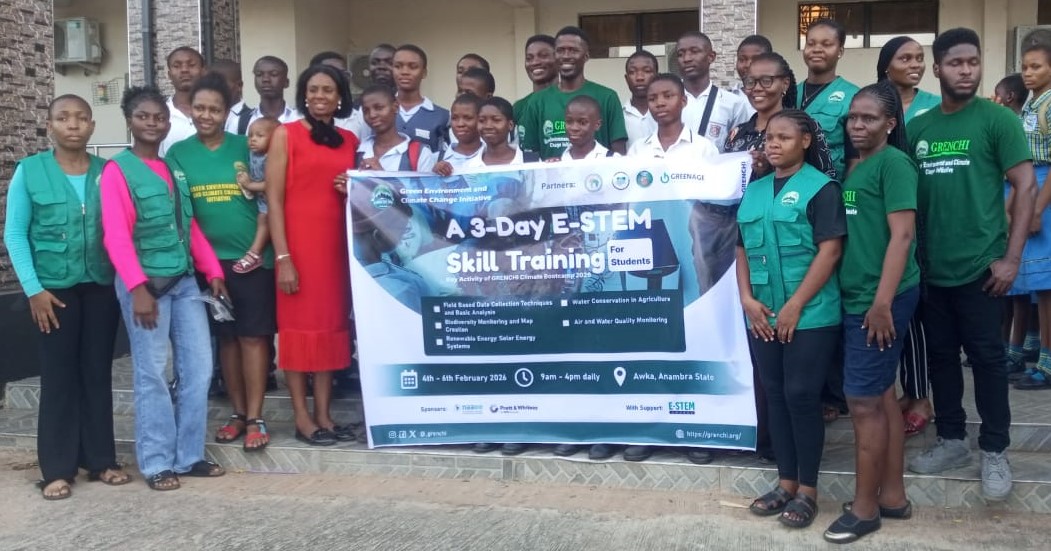
Some secondary school teachers have described the recently-held three-day E-STEM climate boot camp organised by the Green Environment and Climate Change Initiative (GRENCHI), as a rewarding.
The teachers who accompanied their students to the event said it was more than an academic exercise but also inspiring, eye-opening and deeply fulfilling.
From biodiversity lessons to hands-on solar installations and water-smart agriculture, the educators said they felt proud, excited and optimistic watching their students acquire practical skills rarely taught in conventional classrooms.
Mrs. Stella Anayo of Community Secondary School (CSS), Enugwu-Agidi, described the programme as engaging and impactful from start to finish.
“It has been a very nice occasion. The NGO tried very well by bringing us here,” she said.
According to her, the first day focused on biodiversity, where students learned about birds, plants and animals, including identifying trees by their scientific names.
“It was very fun,” she noted, explaining that the students were fully involved and curious throughout the sessions.
New perception of agriculture
The agriculture training also left a strong impression on her. “The students were taught practical techniques such as how to properly water corn before planting and what to apply to yam before placing it in the soil.
The visit to the zoo was another highlight. Mrs. Anayo admitted that the experience was as exciting for her as it was for the students.
“My students said it was the first time they had seen a lion alive. It was very exciting,” she said.

“We saw many other animals, including big snakes. The handler explained that one of the snakes was not venomous, that it only has strength and can strangle. I didn’t even know that some snakes do not have venom.”
On the final day, students learned map-reading calculations and how to connect solar panels—skills Mrs. Anayo believes will have lasting impact.
“We have already planned what to do when we return to school. We will secure a portion of land to plant crops and establish an orchard.
Practicalizing learning
“Students who excelled in the solar training will attempt to replicate the installation at school.
“Even if it is just to provide a way for teachers to charge their phones, we will start from there.
“We are sure the knowledge will not die,” she added, expressing gratitude to GRENCHI for the opportunity.
Mrs. Chidubem Okafor, a club facilitator from Capital City Secondary School, Awka, also spoke passionately about her experience.
She described herself as greatly impressed by the organisation and structure of the training. “A lot has been learned here,” she said.
“The training was divided into three major areas—water conservation in agriculture, renewable energy and biodiversity conservation and which are critical in today’s world.
“Water conservation in agriculture is very important because land and water are limited, especially with global warming.
“Students were introduced to modern concepts such as hydroponics and vertical farming to increase food supply.
On renewable energy, she described it as a game-changer and emphasized the importance of collaboration between organisations and young people.
Energy and experience
“The young ones have the energy, and we have the experience. If we collaborate, we can achieve great results,” she said.
Mrs. Okafor expressed optimism that the knowledge gained would grow with the students.

“It is not just about planting trees; it is also about planting knowledge in children. When you plant knowledge, it grows and blossoms like an oak tree,” she said.
However, she called on government to fund more practical initiatives like the boot camp, noting that only 15 students from her school—out of thousands—could attend.
“Such exposure changes mindsets and prepares them for the future. More students need to be trained,” she stressed.
Anulika Nwabude, a teacher from Nwafor Orizu Demonstration Secondary School, Awka, described the programme simply as “wonderful.”
“Students learnt a lot,” she said, highlighting the renewable energy session where students practiced installing solar panels. “We saw them try to connect.”
She added that students involved in biodiversity conservation engaged in map-reading calculations, while those in water conservation agriculture gained practical insights.
Excitement at zoo
“The zoo visit was exciting not just for the students but also for the teachers.
“I thank the organisers, GRENCHI, for putting this together.
“When we get back, we will find a space to establish our own orchard and practicalize other things we’ve learnt. They won’t be in vain.”
For the teachers, the training was not just a programme but a renewed sense of possibility, a reminder that with the right exposure, young minds can be equipped to tackle climate challenges with confidence and innovation.