Ukpa Ewa
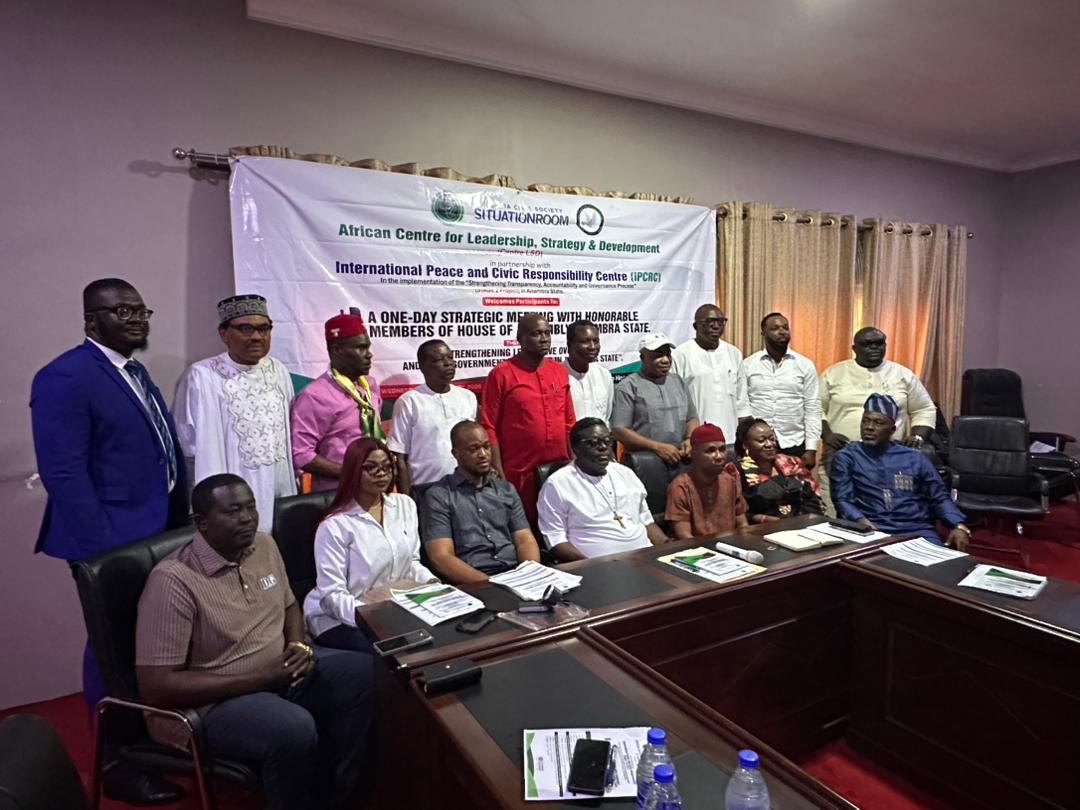
The African Centre for Leadership, Strategy and Development (Centre LSD), in partnership with the International Peace and Civic Responsibility Centre (IPCRC), has engaged members of the Anambra State House of Assembly in a strategic dialogue aimed at strengthening local government administration and improving accountability at the grassroots.
The one-day meeting, supported by the Nigerian Civil Society Situation Room, formed part of activities under the Strengthening Transparency, Accountability and Governance Process (STAGE 2) project.
It focused on enhancing legislative oversight, promoting transparent governance, and reinforcing democratic practices within local government councils across the state.
Addressing participants, the Speaker of the Anambra State House of Assembly, Mr Somtochukwu Udeze, commended the organisers for initiating what he described as a timely and necessary engagement, particularly as preparations for local government elections continue.
He recalled that the House, in October 2024, passed a comprehensive Local Government Administration Law designed to strengthen governance structures and service delivery at the grassroots level.
Support for autonomy
While reiterating the Assembly’s support for local government autonomy, Udeze noted that certain functions, such as primary education and primary healthcare, remain joint responsibilities among the federal, state and local governments.
He stressed the need for clear legal frameworks to ensure coordination and efficiency.
“Autonomy does not mean isolation,” the Speaker said, adding that collaboration among the three tiers of government is critical to achieving effective service delivery for citizens.
Earlier, in his welcome address, the Executive Director of Centre LSD, Mr. Monday Osasah, said the theme of the engagement—“Strengthening Legislative Oversight and Local Government Leadership in Anambra State”—reflects the central role of local governments as the closest tier of government to the people.
Osasah explained that the STAGE 2 project, supported by the United Kingdom Government through the Foreign, Commonwealth and Development Office (FCDO), seeks to deepen democratic governance in Anambra State by strengthening institutions and accountability mechanisms at the local level.
He noted that the initiative builds on the achievements of STAGE 1, which mobilised citizens and stakeholders to demand the conduct of local government elections after nearly a decade of delay.
Successful advocacy
According to him, those advocacy efforts culminated in the successful conduct of elections in all 21 local government areas of the state in September 2024.
Also speaking, the President of IPCRC and Chairman of the Anambra Civil Society Network, Prince Chris Azor, said the second phase of the project is focused on sustaining the democratic gains already recorded.
He explained that STAGE 2 prioritises capacity building for elected local government officials while strengthening institutional frameworks that promote transparency and accountability.
Azor emphasised the importance of continuous engagement between civil society organisations and lawmakers to ensure responsive and people-centred governance.
Delivering a paper titled “Effective Oversight of Local Government Administration in Anambra State: Constitutional, Judicial and Legislative Perspectives,” the Publicity Secretary of the Nigerian Bar Association (NBA), Awka Branch, Barr. Michael Ozojiofor, examined the legal complexities surrounding local government autonomy.
Grey areas in Apex Court decision
He highlighted recent Supreme Court decisions that reaffirm financial autonomy for local governments but observed that tensions persist between state oversight powers and evolving judicial interpretations.
According to him, these grey areas may require constitutional amendments to achieve clarity and balance.
Lawmakers at the event described the engagement as insightful and impactful.
Noble Igwe (Ogbaru I) called for a comprehensive constitutional review to resolve issues relating to financial autonomy and joint responsibilities, while Mimi Azikiwe (Onitsha North I) described the discussions as thorough and constructive.
Tony Muobike (Aguata II) reaffirmed the commitment of the Anambra State House of Assembly to strengthening the local government system through sustained legislation, oversight and the conduct of regular elections.
Participants expressed optimism that the engagement would translate into improved transparency, accountability and effective governance across all local government areas in Anambra State.