
Ifeanyi Ejiofor, Esq.
There is a particular British talent, practised, polished, and never quite repentant for converting an appearance of bonhomie into a pedagogical demonstration of patronage.
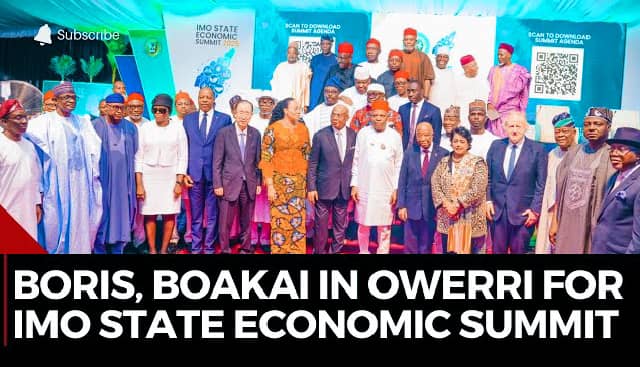
On Thursday, at the Imo State Economic Summit in Owerri, that talent found a familiar vessel in Mr. Boris Johnson, former Prime Minister of the United Kingdom.
In language at once jocular and jarring, he catalogued the “exports” binding Britain and Nigeria: oil and gas; Nollywood; “brilliant doctors, nurses, tech geniuses”; and—with the comic timing of a man convinced that humour absolves impertinence, Britain’s “huge quantities of whisky,” pharmaceuticals, bankers, and “services of all kinds.”
He even reached for geopolitical levity: “We send you former United Kingdom prime ministers, and you send us future United Kingdom prime ministers,” invoking Kemi Badenoch as a Nigerian-rooted exemplar.
Let us be plain: Mr. Johnson’s remarks were neither a study in trade flows nor a felicitous toast. They were a jaunty recapitulation of an imperial mindset that refuses to retire.
Microcosm of unequal memory
That eminent Africans sat on the dais—Aliko Dangote, Prof. Benedict Oramah, and others—only amplified the dissonance. Their presence made his quips not an awkward aside but a rhetorical microcosm of unequal memory.
The insinuation that Britain supplies “whisky and pharmaceuticals” while Nigeria supplies crude oil and migrants is not innocent banter. It is a shorthand summoning centuries of asymmetric exchange—from mercantilist trafficking through the Atlantic age to post-colonial structural dependency.
To joke about that ledger in 2025 is to be wilfully tone-deaf. An economic summit ostensibly committed to genuine partnership was, therefore, the worst venue for such rhetorical amnesia.
Decades of scholarship have shown how colonialism survives in attitudes, institutions, and habits of mind. When a guest from a former imperial power frames partnership primarily in terms of what his country sells and what ours supplies, he revives precisely the ordering of worth that underwrote empire.
A statesman of Mr. Johnson’s pedigree ought to know better—or at the very least possess the tact to conceal the assumptions he so casually displayed. That he did not is revealing.
One may forgive a misjudged foreign joke. But the rapid, enthusiastic applause that followed from a largely Nigerian and African audience—including business titans and public figures—raises deeper concerns.
It betrays either an eagerness to normalise condescension for the sake of conviviality or the well-worn transactional instinct to earn social currency by indulging power. If the latter, it is a painful reminder that proximity to wealth often mutes dignity. African leadership must resist applause that masks self-demeaning acquiescence.
Squandered opportunity
If Mr. Johnson intended satire about interdependence, he squandered the opportunity to discuss real issues: mutually beneficial trade terms, technology transfer, rules of origin, regional value chains, pharmaceutical manufacturing capacity, or skills mobility.
Instead, he offered a caricature of bilateral relations rooted in consumption rather than collaboration. A summit themed “Unlocking Imo’s Economic Potential” deserved substance, not a reenactment of centuries-old imbalance.
The offence lies not only in Mr. Johnson’s words but also in the social choreography surrounding them. When eminent Africans—financiers, industrialists, policymakers—sit in polite silence as their nation is publicly diminished, the spectacle drifts from bilateral dialogue to a theatre of complicity.
Diplomacy demands decorum, yes: protocol, investment courting, and the desire to avoid public scenes. Yet there is a higher duty—to resist the normalisation of contempt dressed as comedy. To accept a quip reducing centuries of African ingenuity to commodities is to allow an intellectual slight to harden into policy ambience.
What should follow is not performative outrage but corrective candour. Nigeria and Africa more broadly—must:
Addressing economic summit
If one is invited to address an economic summit, one must bring analysis, policy insight, or at least modesty. Public platforms carry public responsibilities.
Trade is never merely transactional; it shapes esteem. Nigeria must insist that partnership emphasise capacity-building, technology transfer, value addition, and regulatory reciprocity not recycled hierarchies.
If external rhetoric reduces relations to bottles of whisky and flattering stereotypes, Nigerian consumers, regulators, and institutions have every right to reassess where they place their custom and how they demand better terms. Constructive reciprocity is ideal; symbolic sanctions may sometimes be necessary.
There is exquisite irony in a former tenant of 10 Downing Street celebrating Nigeria’s “exports” of brilliance while breezily reproducing the logic of an eighteenth-century export relationship. If empire had a gift shop, its price list might read: crude for commodities; people for prestige; humour for reconciliation.
Perhaps when Mr. Johnson next returns, he might bring not only “huge quantities of whisky” but also a pocket-sized volume of contemporary economic history—and the humility to read it aloud.
Nigeria has the right, indeed the obligation, to embrace only partnerships that dignify. Anything less is ceremonial obeisance set to the soundtrack of applause.
Sir Ifeanyi Ejiofor, Esq. (KSC)
Renowned Nigerian human rights lawyer, Abuja.