
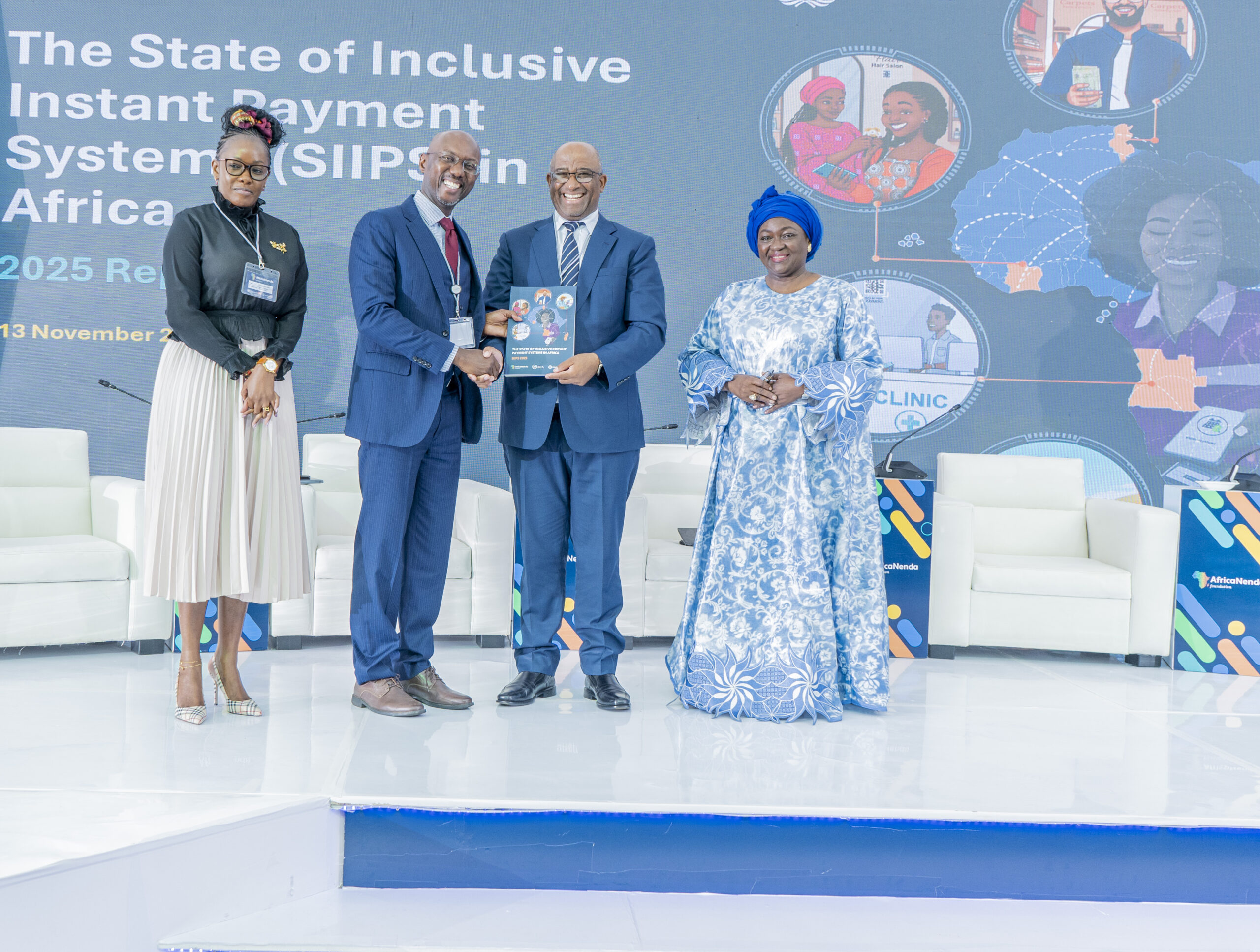
Africa’s digital payment ecosystem is growing faster than ever, signalling a major leap toward inclusive and interoperable financial systems across the continent.
The State of Inclusive Instant Payment Systems (SIIPS) 2025 Report was released by the AfricaNenda Foundation in partnership with the World Bank and the United Nations Economic Commission for Africa (UNECA).
It paints a picture of a rapidly digitizing continent where instant payments are expanding economic participation, innovation, and opportunity.
Now in its fourth edition, SIIPS has become Africa’s benchmark study on inclusive instant payment systems (IIPS).
The 2025 report shows that 36 systems are live across 31 countries, with five launched in the past year.
Collectively, they handled 64 billion transactions valued at nearly USD 2 trillion in 2024.
This reflects Africa’s accelerating shift to digital finance.
“Inclusive instant payments are transforming how Africans connect economically,” said Dr. Robert Ochola, CEO of the AfricaNenda Foundation.
“The findings show clear progress — more countries are adopting these systems.
“More people are gaining access to digital financial services that drive livelihoods, trade, and growth.”
At the World Bank, Niraj Verma, Acting Global Director for Finance, Competitiveness & Investment, noted that fast payment systems remain central to financial inclusion and economic growth.
“Countries without fast payment systems should begin implementation.
“Those already operating them must deepen inclusivity, innovation, and affordability,” he said.
“Regional payment models offer cost-efficient, speedy cross-border transactions and should be scaled continent-wide.”
Interoperability and Inclusion on the Rise
The report reveals that nearly half of Africa’s instant payment systems now link banks, mobile money operators, and fintechs through cross-domain platforms — a milestone for interoperability.
Nigeria’s Instant Payments (NIP) became the first system to reach “mature inclusivity” on the AfricaNenda Inclusivity Spectrum.
“Ten others advanced to the “progressed” level.
Beyond person-to-person (P2P) transfers, more systems now support person-to-business (P2B), government-to-person (G2P), and cross-border payments — widening access for both consumers and enterprises.
Field studies in Angola, Côte d’Ivoire, Madagascar, and Tunisia reveal that individuals are adopting digital payments faster than merchants, especially in emerging markets.
Adults above 30 and those with regular income remain the most active users.
Women and young adults face persistent barriers such as fraud concerns, lack of identification, and limited access to agents.
Between 50% and 75% of cash-first users cited fraud risks as a key barrier to adoption.
“For digital payments to reach everyone, inclusion must be intentional,” said Dr. Mactar Seck, Chief of Section, Innovation and Technology at UNECA.
“The SIIPS 2025 data gives policymakers the evidence to design ecosystems that serve marginalized groups.
“These include women, youth, informal workers, and rural communities.”
Next phase of Africa’s digital economy
The report underscores the transformative potential of digital public infrastructure (DPI), G2P payments, and cross-border interoperability.
“36 countries already operating instant payment systems — and most adopting digital IDs and data protection laws.
“Africa is poised to create a more connected and secure digital economy.
“To scale G2P and cross-border use cases, SIIPS calls for stronger regulatory harmonization.
“Broader digital identity coverage, and closer collaboration between public and private sectors.
“These are key to achieving Africa’s ambition of a single, digitally connected market.
The SIIPS 2025 launch is hosted by the Central Bank of Eswatini (CBE) from November 11–14, 2025.
It gathered central banks, payment operators, policymakers, and development partners to explore how instant, inclusive payments can shape Africa’s financial future.
The full report, featuring country case studies, data insights, and policy recommendations, is available at www.africanenda.org/en/siips2025.