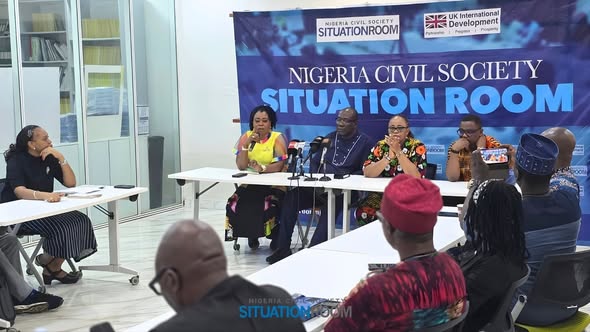
The Nigeria Civil Society Situation Room (Situation Room) has described the 2025 Anambra State Governorship election, held on Saturday, 8th November, as largely peaceful, while highlighting persistent challenges including vote buying, low voter turnout, and abuse of state power.
The final statement, issued on Monday, 10th November, draws on observations from accredited monitors deployed across all 21 Local Government Areas (LGAs) and reports from partner organizations.
Situation Room noted that the electorate largely conducted themselves calmly, with only isolated incidents of violence. Partner organization Kimpact Development Initiative (KDI) recorded 35 incidents across 1,000 polling units, including group clashes, voter intimidation, harassment, ballot box snatching, and one fatality.
While commending the Independent National Electoral Commission (INEC), security agencies, and election workers, the Situation Room emphasized that the primary drivers of the peaceful environment were the people of Anambra State.
“Their collective commitment to maintaining a conducive and calm electoral environment was pivotal to the positive ambience observed across the State,” the statement noted.
Election administration: efficient but with hiccups
INEC was praised for effectively managing core processes. Polling opened slightly late in several locations due to delayed arrival of officials, but the average opening time was 9:15am.
“The Bimodal Voter Accreditation System (BVAS) functioned optimally in most units, though isolated malfunctions required replacements.
Situation Room particularly commended the quick and drama-free results collation process, noting that 97% of polling unit results were uploaded on the INEC Results Viewing Portal (IReV) within five hours after polls closed, a development described as “encouraging.”
However, assistive materials for Persons with Disabilities (PWDs), such as braille guides and magnifying glasses, were inconsistent. Priority voting was largely respected for elderly voters, pregnant women, nursing mothers, and PWDs.
Security: strong presence, limited action
Security agents were widely visible and conducted their duties with civility. Senior officers from the Nigeria Police Force, NSCDC, DSS, and other agencies were deployed across the state, with many arriving at polling units before 8:00am.
Yet, the Situation Room highlighted the reluctance of security personnel to take decisive action against vote buying. “Despite this strong presence, the widespread practice of vote buying continued unabated during the electoral exercise,” the statement warned.
Transactional nature of elections
The Situation Room expressed deep concern over the transactional nature of Nigerian elections. It noted that the political elite often operate on a “Machiavellian understanding” that the end justifies the means, sidelining democratic ideals.
Vote selling, fueled by citizens’ economic vulnerability, was rampant in Anambra. The Situation Room warned that this reflects a broader failure of the political class to connect democracy with tangible benefits for citizens.
The civil society coalition criticized the lack of commitment from several political parties to competitive electioneering. It called for stricter criteria for party participation and stronger accountability mechanisms ahead of the 2027 general elections.
The Situation Room also raised concerns over the abuse of state power by incumbents. In Anambra, restrictions were placed on campaign signage, billboards, and market campaigns, creating an uneven playing field.
“Elections should be seen to be a level playing field for all candidates and parties and not lopsided in favour of the incumbent candidate,” the statement said, calling for reforms that criminalize such actions.
Voter turnout: Slight improvement but still low
Voter participation was estimated at just 21% of registered voters, a marked improvement over the 10% recorded in the 2021 governorship poll. Situation Room urged deeper reflection on strategies to overcome voter apathy, while commending civil society organizations, including its partner, the Social and Integral Development Centre (SIDEC), for voter education and mobilization activities in rural communities and markets.
The 2025 Anambra election, the Situation Room concluded, was peaceful but highlighted lingering distrust in public institutions and governance. Citizens’ disinterest in the process and continued engagement in vote selling underscore structural challenges in Nigeria’s democracy.
The coalition called for: strict enforcement of laws to reduce vote buying, acceleration of pending electoral reforms by the National Assembly, stronger collaboration among INEC, security agencies, political actors, and civil society to safeguard credible elections as well as addressing voter apathy and ensuring welfare of security personnel.
Situation Room warned that these lessons must guide upcoming elections, including the FCT Area Council elections and Ekiti and Osun governorship polls in 2026, and emphasized that electoral accountability is essential to sustaining Nigeria’s democracy.
Signed by Yunusa Z. Ya’u, Convener of the Nigeria Civil Society Situation Room, the statement reiterated civil society’s commitment to continuous advocacy for credible, transparent, and inclusive elections.